Who you use for a mortgage loan matters.
Let’s walk through a very real scenario that happens all the time when someone is considering refinancing their home.
Imagine you currently have a 6.25% conventional mortgage. You’re looking at refinancing because you see interest rates drifting lower. You call a lender and they quote you 5.25%. That sounds pretty appealing. Naturally, you want to make sure you’re getting the best possible deal, so you get a second opinion.
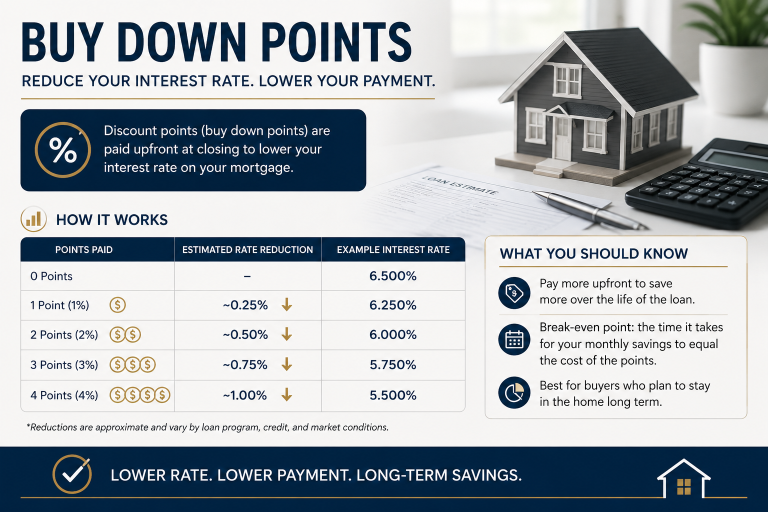
The next lender also quotes you 5.25%, but this lender is charging three points on the loan.
Let’s assume the loan amount is $600,000.
Three points equals $18,000 in points. Once you add in title and escrow fees, which are probably another $3,500 or so, you’re now spending more than $20,000 to refinance the loan.
So now we have to ask the real question.
Is it worth spending over $20,000 just to lower your interest rate by one percent?
It could be in some situations. But more often than not, the answer is probably not.
On a $600,000 loan, the difference in payment might be roughly $381 per month. That sounds great on the surface. But when you divide the cost of the refinance by the monthly savings, your recapture period can stretch out for years.
That becomes a problem when you consider something very important: mortgage rates move in cycles.
If rates decline again in the next couple of years, there’s a good chance you’ll want to refinance again. If that happens before you’ve recovered the money you spent on the refinance, then that expensive rate buydown becomes money you’ll never see again.
There is another strategy that many borrowers overlook.
Instead of paying a massive amount in points to chase the absolute lowest rate, you could choose something like 5.50% or 5.625% with little or no closing costs. In many cases, this is done through lender-paid compensation, where the lender structures the loan so the rate covers the closing costs.
Yes, the interest rate may be slightly higher.
But the recapture period might be a year or less, sometimes even shorter.
Now you’re keeping your money working for you instead of handing over $20,000 upfront. And if rates fall again, you’re in a perfect position to refinance again without feeling like you just lit a pile of cash on fire.
That’s where the experience of the mortgage professional you’re working with becomes extremely important.
Another thing to evaluate is who you’re actually speaking with.
Go to the **NMLS Consumer Access website and look up the loan officer you’re talking to. This site will tell you how long that person has been licensed as a mortgage loan originator.
If someone has only been in the business a year or two, that might be something you want to evaluate. Mortgage lending is not a simple product. There are nuances in pricing, structuring loans, and understanding the long-term implications of a refinance decision.
Experience matters.
Another important question is this: how many states is this person licensed in?
If the person you’re speaking with is licensed in eight, nine, ten states or more, there’s a good chance they’re working in a call center environment. These operations typically take inbound calls, quote mortgages all day long, close the loan, and then move on to the next person in line.
That doesn’t necessarily mean they’re bad at what they do.
But you should ask yourself a few questions.
Is this someone who will make a real commitment to you on rate and price?
Is this someone who will personally ensure your loan performs and closes on time?
Is this someone who will advocate for you if problems arise during underwriting?
Or are you simply another file in a large pipeline?
If your loan doesn’t close on time and your rate lock expires, you may be forced to pay a rate lock extension fee, which can cost thousands of dollars. Suddenly that “cheapest lender” isn’t the cheapest lender anymore.
Another thing you should absolutely do is Google the person’s name.
How many recent reviews do they have?
If someone has only been in the industry a short period of time and they have only a handful of reviews, that might be something to consider. If someone claims to have been in the business for many years but has no online reviews at all, that’s also something to think about.
Reviews can tell you a lot.
Are clients saying the lender communicated well?
Did the lender close the loan on time?
Did the lender solve problems when issues came up?
Those are the things that matter.
You also have to ask yourself whether someone working in a call center environment is going to represent you in the way you want to be served.
Is someone who just entered the industry the person you want quoting you rates and fees that will shape one of the largest financial decisions of your life?
Maybe it is. Maybe it isn’t.
But it’s worth thinking about.
Compare that with someone who has been in the industry a long time, has significant verified online reviews, and has a track record you can independently evaluate.
Those are the types of things informed consumers look at.
Because choosing a mortgage lender should never be about simply looking at a spreadsheet and saying “I’m going with the cheapest lender.”
The cheapest lender who can’t get the loan done,
who doesn’t put you in the right loan program,
who doesn’t execute quickly,
or who causes you to pay extension fees because the loan didn’t close on time…
And when you add in the excessive points that many lenders are charging today to artificially lower the interest rate on paper, things can start to look a lot better than they actually are.
When you pause for a moment as an informed consumer and peel back the onion, you may realize that what appears to be an apples-to-apples comparison is actually apples and oranges.
These are the kinds of things you should absolutely be evaluating when deciding who to use for your mortgage.
Because in the mortgage world, the lowest rate on paper doesn’t always equal the best lo