
You can have a good job, dependable income, and a real desire to buy a home, yet still feel stuck because the down payment is not sitting in your bank account. That is a common frustration, especially in Sonoma County. Saving several thousand dollars while paying rent, covering family expenses, and keeping an emergency cushion is not easy.
The good news is that a lack of cash for a down payment does not always mean homeownership has to wait. For some buyers, there are programs that can help finance the down payment rather than requiring it all upfront. This is not a magic solution, and it is not the cheapest loan structure. But for the right family, it can be the difference between continuing to rent and getting a foot in the door.
When the down payment is the only thing holding you back
Most buyers know that an FHA loan can allow a down payment as low as 3.5% for borrowers who qualify. FHA financing is often a good fit for first-time buyers, but it is not limited to them. A move-up buyer may use it too, as long as they meet the occupancy and other program requirements.
Here is where the problem can show up. Let’s say you are buying a $600,000 home. A 3.5% down payment is $21,000. You will also need money for closing costs, prepaid taxes, insurance, inspections, and the normal costs of moving. Even with a good income, coming up with that cash all at once can be a tall order.
Some buyers receive a gift from family. Others use an eligible down payment assistance program. Those can be excellent options when available. It is also worth understanding how income, credit, and down payment work together in mortgage approval, because having one piece in place does not automatically solve the others.
But not every buyer has family funds available or qualifies for assistance. That is where a lender-sponsored structure that finances the down payment may be worth a closer look.
How a financed down payment program can work
Security National Mortgage Company offers a program structure in which the buyer’s down payment is financed in-house alongside an FHA first mortgage. Put simply, the FHA loan finances the primary mortgage, while a separate financing arrangement covers the required down payment.
This can allow a qualified buyer to purchase with little or no money required for the down payment itself. Closing costs and prepaids are still separate items to plan for. In some transactions, seller credits may help with those costs, subject to loan rules and the purchase contract. That is different from assuming every cost of buying a home disappears.
Programs like this are harder for many mortgage companies to offer on a broad scale. The lender needs a way to manage the added risk of financing the down payment. That may involve its own capital, an investor or aggregator relationship, or an insurance-backed structure. Security National has a model that supports this type of offering.
The important point is that this is not standard FHA 203(b) financing with your own 3.5% down. It is an FHA first mortgage paired with an additional financing component. Both pieces need to be reviewed before you decide whether the structure makes sense.
The tradeoff: a higher rate and a higher payment
Here’s the thing: financing a down payment has a cost. The interest rate on this type of program may be a little higher than the rate available with a regular FHA 203(b) loan when you bring your own down payment. The additional financing also adds a monthly obligation.
In many cases, the total monthly payment can run around $300 more than a comparable FHA purchase where the buyer has their own down payment. That is only a planning estimate, not a quote or guarantee. The actual difference depends on the purchase price, loan amount, interest rates, credit profile, mortgage insurance, taxes, insurance, and the terms of the second financing.

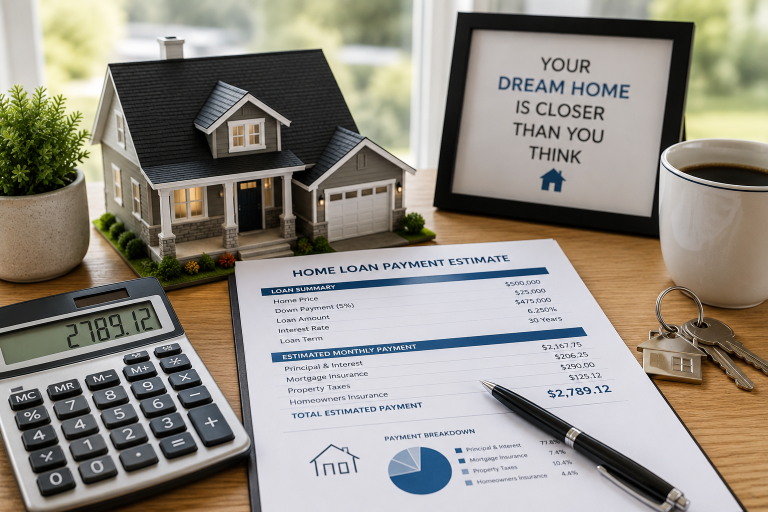
A financed down payment program may help qualified buyers purchase with little or no down payment. Learn the payment tradeoffs and who it may fit – Contact Scott Sheldon and his team to get started.
Let’s say a family can comfortably afford a total housing payment of $4,200 per month. If their standard FHA payment with their own down payment would be about $3,900, the financed-down-payment version might bring the payment closer to $4,200. If that number still fits their budget with room for savings, repairs, utilities, and everyday life, the program could work.
But if the higher payment pushes them to the edge of what they can handle, waiting and saving may be the better call. Qualifying for a payment and being comfortable with it are not the same thing. A lender can calculate debt-to-income ratios, but only the household can decide what feels sustainable.
Look beyond the payment on the worksheet
A higher payment is not automatically a bad decision. It depends on what it helps you do and what you give up in return. If home prices rise while you spend another two years saving, the amount you need to save may rise too. No one can promise what prices or rates will do, but waiting has a cost of its own.
At the same time, buying with no down payment should not drain every remaining dollar. Homeownership comes with repairs, maintenance, and surprises. Keep a realistic reserve after closing. Also make sure the property tax and homeowners insurance estimates are sound, since those numbers can materially change your monthly payment.
For buyers with cash available, it can make sense to compare this structure against a standard FHA loan and other options. You can also review the decision between down payment assistance and a traditional 3.5% FHA down payment. The right answer is often less about finding the lowest advertised rate and more about matching the loan to the buyer’s actual situation.
Who should consider this option?
This approach can be especially helpful for a buyer with stable employment and adequate income who is otherwise ready to own. Maybe they recently started earning more. Maybe their savings went toward a relocation, child care, or paying down debt. Maybe they are paying high rent and can manage a mortgage payment, but have not been able to build the lump sum needed at closing.
It may also help a move-up buyer who has a legitimate reason to purchase another primary residence but does not have ready cash for the new down payment. FHA occupancy rules matter, and having an existing FHA loan can add another layer. If that is your situation, read about when homebuyers may qualify to have two FHA loans.
On the other hand, this is probably not the right tool for someone already stretched by car payments, credit cards, or uncertain income. A financed down payment does not fix a budget that is too tight. It simply solves one specific obstacle: the lack of upfront down payment funds.
Make the decision with the full picture
A good comparison should show the regular FHA option next to the financed-down-payment option. Look at the interest rate, the total monthly payment, estimated cash needed to close, mortgage insurance, and whether the second financing has its own payment or terms to understand. Ask how long you expect to keep the home and whether a future refinance could be realistic if your financial picture improves.
The bottom line is simple. A slightly higher rate and a payment that may be roughly $300 higher can be a meaningful tradeoff. For the right family, it may be worthwhile because it turns a distant plan into a home purchase they can make now. For another family, it may be smarter to save longer. The value is in knowing the difference before you make an offer.
If you have solid income but the down payment is what is keeping you on the sidelines, it is worth looking at the full payment and qualification picture before assuming you have to wait. A program that finances the down payment can be a practical bridge for the right buyer. Get a free mortgage rate quote today.
Share:
RELATED MORTGAGE ADVICE FROM SCOTT SHELDON

Income, Credit, and Down Payment: How Mortgage Approval Really Works
Mortgage approval is about more than a credit score. Learn how income, debt, credit, and down payment work together when buying a home.

How to Get an FHA Loan After a Six-Month Employment Gap
An FHA loan may still be possible after a lengthy job gap. Learn the six-month return-to-work rule, the two-year work history requirement, and how timing affects a purchase or refinance.
Could FHA Mortgage Insurance Be Reduced Again? Here’s What Homebuyers Should Know
If you’ve been thinking about buying a home with an FHA loan, you may have…

Could Conventional Mortgages Become Assumable? The Industry Is Talking, But Nothing Is Official Yet
One of the biggest challenges facing today’s housing market isn’t necessarily home prices—it’s something many…
View More from The Mortgage Files:
begin your mortgage journey with sonoma county mortgages
Let us make your mortgage experience easy. Trust our expertise to get you your best mortgage rate. Click below to start turning your home dreams into reality today!